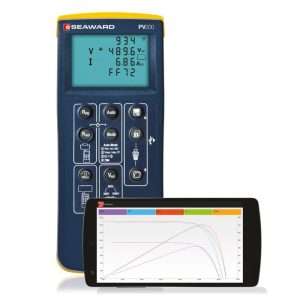
What can the PV200 offer? Click to learn more about Seawards PV range and their IV Curve Tracing.
It’s a sunny day and you’ve just started a new Solar installation project, everything is going as planned, until you discover some discolouration on the panels. Do you postpone the project and order some new ones? Or do you investigate if they are still functional, and save time, costs, and materials in the process? That’s the situation solar panel installation company 8MSolar found themselves in. Discover how a call to Seaward USA helped them keep the project on track.
What could be done and was is too late?:
Having designed and completed over 2,000 commercial and residential solar installations, 8MSolar spearheaded the installation of a 135 kW system located on the newly constructed East Campus. Using 283 480W Hanwha QCell bifacial modules, the system consists of different arrays across multiple roof planes and racking types.
Midway through the project, it was discovered that a handful of these modules had minor discoloration that occurred during shipping or storage.
To ensure that system production values met expectations, 8MSolar reached out to Seaward for guidance on how to confirm there were no production related issues.
IV curve tracing was carried out on 40 individual modules by the PV200 to confirm performance had not been compromised by the glass discoloration. The test data was then compiled in Seaward’s SolarCert software, to produce a report for 8MSolar and Wake Tech, and verified that the system was fully functional.
This news allowed 8M Solar to continue the necessary steps to complete the installation and project commissioning.
After a day of testing with the Seaward handheld device, 8MSolar project manager Chris Pate commented, “The PV200 is easy-to-use and requires no configuration prior to testing.
While spending the time to test individual modules is rarely the first option, it’s always a possibility, and given the module level RSD’s installed on this project actually a requirement. In this case the extra steps prevented further project delays and assuaged the college’s concerns with hard data.”
Utilizing a device such as the PV200 can provide valuable insight into the performance characteristics of a specific module, or string of modules both prior to system operation and during regular O&M. IV curve tracing will provide sufficient data to confirm production values for each string/panel in seconds, ensuring system production expectations are satisfied.
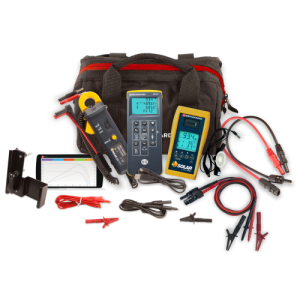
Using simple push button operation, the Seaward PV200 is an all-in-one device that can carry out the majority of electrical tests required to verify a solar installation’s safety and efficiency, including IV curve, ground bond, and insulation resistance. It forms part of a comprehensive range of Seaward solar PV testing equipment, and since the UL3741 standard is becoming more prevalent amongst users, testers like the PV200 will become even more crucial.
Key features of the Seaward PV200
- All-in-one commissioning tests and I-V curve tracing.
- Automatic fill factor calculation.
- Ground (earth) continuity measurement with test lead null.
- PV string open circuit and maximum power point voltage measurements up to 1000V DC.
- PV string short current up to 15ADC.
- PV array insulation test at 250/500/1000V.
- Tests individual PV modules or strings.
- Memory for up to 999 records with USB download to PC.
- Instant NFC data transfer using the PVMobile app.
- High contrast display, visible in bright light.